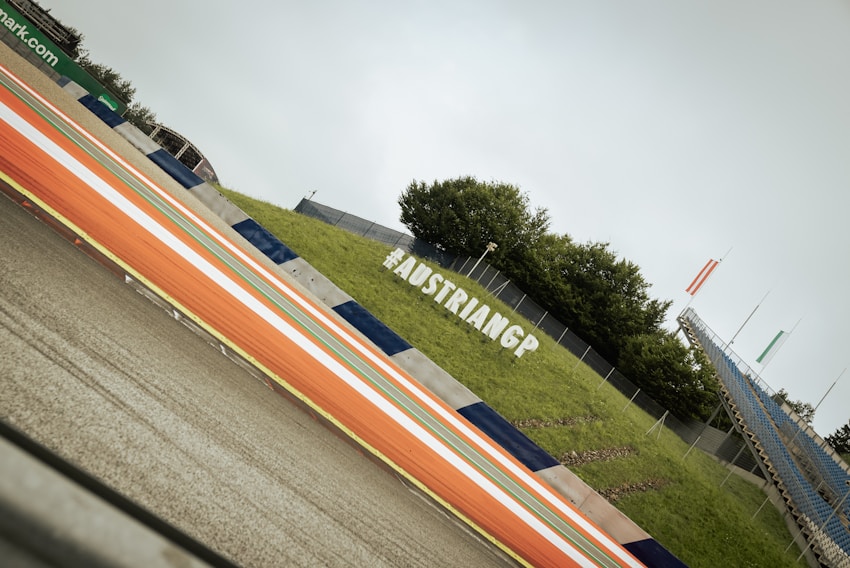
Photo by Chris Kursikowski on Unsplash
The European leg of the 2026 Formula One season continues this weekend as the championship heads to the Red Bull Ring for the Austrian Grand Prix, a race that has quietly become one of the most dramatic and unpredictable fixtures on the calendar.
Lewis Hamilton's masterclass in Barcelona, delivering his first Ferrari victory, has blown the title fight wide open.
With championship leader Kimi Antonelli retiring from that same race, the gap has shrunk to 41 points, while George Russell sits just nine points further back. Momentum has shifted, and the pressure is building across a tightly packed front group.
That tension extends to online casino sites heading into Spielberg, with Antonelli, Russell, Hamilton, and Leclerc all in close contention.
It's tough to call a winner, and it's exactly the kind of uncertainty Austria is known for producing. Before the lights go out this weekend, it is worth looking back at why this particular race has developed such a reputation for unpredictability.
Recent History of the Austrian Grand Prix (2021–2025)
2025 – Norris leads McLaren breakthrough
McLaren delivered a statement weekend at the Red Bull Ring, with Lando Norris leading Oscar Piastri home in a controlled 1–2 finish. Their pace through the middle sector and strong traction out of slow corners allowed them to dictate the race once in clean air.
It was a clear sign of McLaren's step forward in race execution, turning raw speed into control over a full Grand Prix distance. Red Bull, meanwhile, were unable to fully assert their usual dominance at home.
2024 – Russell wins strategic battle
George Russell took victory in a race shaped more by strategy and timing than outright pace. Mercedes kept themselves in contention through consistent execution, and Russell was able to capitalise as the front of the field fractured in the closing stages.
McLaren again showed strong long-run performance, but it was Mercedes who timed their race to perfection. Austria once again proved that positioning and pit strategy can matter as much as pure speed.
2023 – Verstappen in control
Max Verstappen converted pole position into victory in a controlled Red Bull performance at their home circuit. While Ferrari remained the closest challenger on pace, they never quite had the race execution to seriously threaten the lead.
It was a more traditional Spielberg outcome, with Red Bull managing the race from the front. Verstappen's consistency and ability to avoid pressure proved decisive once again.
2022 – Leclerc holds off Verstappen
Charles Leclerc took victory in one of the more competitive Austrian races of the modern era, holding off sustained pressure from Max Verstappen in the closing stages. Ferrari's tyre management and race pace allowed them to stay competitive throughout.
The race was defined by a genuine front-running fight rather than strategic chaos. Ferrari's ability to match Red Bull over a stint made this one of the closer Spielberg battles in recent seasons.
2021 – Verstappen dominant at home
Max Verstappen delivered a commanding win at Red Bull's home circuit, controlling the race from the front with clear pace advantage. The Red Bull package was particularly strong around the short, traction-heavy layout.
It was an early example of Austria becoming a Red Bull stronghold. Verstappen never looked under threat, setting the tone for future dominance at the circuit.
What the Vault Tells Us
Looking at these five years of results, a clear picture emerges. Austria rewards:
● Teams with strong traction and confidence in slow-corner performance. McLaren and Red Bull have traditionally excelled here.
● Teams with meticulous pit strategy and race execution. Mercedes showed this in 2024. Ferrari proved it in 2022.
● Drivers who can handle pressure and manage tyres intelligently over long runs. Leclerc and Russell both demonstrated this.
● Drivers or teams who avoid mistakes. Small errors compound into larger problems over a short lap length where everyone is constantly braking and accelerating.
The vault of recent winners suggests that execution, strategy, and tyre management matter more than absolute pace. For teams and drivers who can master all three, Spielberg rewards them handsomely.