This weekend the Automotodrom Brno hosted well promoted Historic Grand Prix meeting. It was mainly focused on historic formula 1 racing cars. But we were there mainly due to so called FIA Masters Historic Sports Car Championship, which is destined for Sports Cars and Prototypes of the 1962-1974 era. It was our second trip to Brno this year after the spring HistoCup and following the cancellation of the GT Sprint Cup planned during the EuroV8 Series weekend because of only two GT cars entered (we believe Tomas Enge with Reiter Camaro being one of them). The GP programme was based around Formula One cars from 1974-1985 (The FIA Masters Historic Formula One Championship) and even older Formula 1 cars running under The Historic Grand Prix Cars Association banner. These HGPCA cars ran in two races: car built until 1961 and then more modern cars built by 1966.


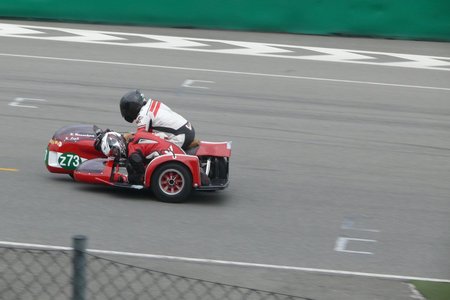
Entire programme was supported by FIA Lurani Trophy for Formula Junior cars and Gentlemen Drivers pre-1966 GT cars & Touring cars. And it was not all. The really full-filled racing programme also accommodated Haigo Formel and Haigo Tourenwagen races. They were determined for cars built and racing in former Eastern-block countries, mainly from Czechoslovakia, the Soviet Union and the German Democratic Republic. Apart from those races there were also demonstration runs for racing cars and for motorcycles. And even they were far from being boring. More about them later.


As it is usual with historic racing, the results are not that important, and rarely many drivers are well-known, but here we had a few exceptions. One of the fastest Lola T70 was to be co-driven by an active sports car driver, and former F1 driver, Arturo Merzario. Unfortunately, Arturo could not arrive and became a last minute withdrawal. But the real star of the weekend was six-time Motorcycle World Champion Jim Redman, who is also multi-ply Tourist Trophy winner. He, now 82 year old man, ran several demonstration laps during the motorcycle runs, wearing a symbolic number 1.


Unfortunately, the event schedule, despite almost identical for Saturday and Sunday, was not much friendly for a sports car fans. The powerful prototypes had just one appearance scheduled for entire weekend. It was the one hour race on Saturday evening. The pre-1966 GT cars had their 90-minute race on Sunday morning, but were seen also on Saturday during their qualifying session. Considering all this, we opted to visit only Saturday, which as the only day offered appearance of both Prototypes and GT, though just once. It was the consequence of the full racing programme. Formula classes, enjoyed two races, one each day. But they were much shorter. Usually 20 or 25 minutes.


Saturday morning started with a number of qualifying sessions. During those we took most of the photos presented here in the gallery. Just FIA Masters F1 and Sports Car are from the race, as both classes had their qualifying session on Friday - the fact, which was listed almost nowhere, neither on the official website, nor in the race programme. Just in media version of the schedule.


The FIA Masters Historic Sports Car Championship
All twelve entered cars arrived to Brno and all of them were also gridded for their one our race, which started late at 5 PM. The front row was occupied by duo of Lola T70. Those were the later model Mk IIIB in a coupe version. Another Can-Am Lola T70 without the roof was also present, but nowhere near the pace of the two. Apart from a number of two litre cars, mainly Chevrons and Lolas, there were several other Vee-Eight powered machines. But only one could match the Lolas, as well as beat the two-litres. It was Huffaker-built Genie Mark 10. Couple of Cooper Monacos were mid-field runners and the lone famous Ford GT40 was a real outsider.


The Genie soon after the start split the Lola Coupes and thus prevented their dominance, which was hugely expected by the commentator Martin Straka, who is known from TV racing commentary, especially Le Mans. Recently he is also a frequent host at Czech and Slovak circuit and he is doing his job really well. Nevertheless in this case, his prognosis did not fulfilled completely and we had not just two cars at the front, but four. The last one was a Chevron B19-bodied, B23-entered two litre prototype, which in hands of Tim Cousins set the fastest lap of the race and kept well with the much more powerful cars. Unfortunately, when he looked to take second position overall, he was forced out with a mechanical troubles some four laps before the finish.


By that time, one of the quick T70s had been stationary for a long time in its garage. Pierre Tonetti, the driver of the Genie was also out of the race at this moment. After the mid-race mandatory pit-stop he still kept second position but would hardly keep it, even if not retired. The Chevron was quicker in the second half of the race, and overtook it. And then Tonetti was two quick in the pit-lane, so he was already penalised by a 10-second Stop & Go penalty. But he track-sided his car even before he could satisfy this penalty.


This all left the leading Jason Wright, who was scheduled to share his car with the Arturo, with no opposition. Needless to say, that he would have won anyway after leading entire race and having a slight advantage about all quick cars, even when they ran all together before having been hit by various troubles.


After the quick car meltdown, the second position in the finish fell into hands of Graham Adelman, who was also a 2-litre winner in his Lola T210. Andrew Newall, third in JCB-coloured Chevron B8, was already lapped by the winner, who managed to complete 26 laps. By the way, while these prototypes run slightly under 2:15 in Brno, ten years younger Formula 1 cars could lap almost 20 seconds per lap quicker.


The FIA Masters Historic Formula One Championship
Eleven cars gridded for the F1 races. It was nice to see Williams FW08C in the last row. Especially after Richard Barber missed the qualifying session. He was able to prepare the car for the race. Two Arrowses and Ensign, unlike during their hey-day, dominated the race and James Steve Hartley in one of Arrowses could celebrate a victory after 25-minutes of racing.


The Historic Grand Prix Cars Association
Two races full of interesting cars from late 50s and first half of the 1960s, represented by Lotuses, Coopers, Maseratis and a lone Ferrari brought two interesting races. Not that much sound around the track, like during the two races, which we already reported, the top speed on the main straight was surprisingly good.


To complete the photos, let us say that the 1966 race was won by Peter Horsman in a Lotus 18/21 ahead of two Coopers and another Lotus. The race for older cars had Guillermo Fierro in a beautiful front-engined Maserati no.21 in the front ahead of an Aston Martin DBR4 and Alta F2. The Race 2 results were still not available online by the time of this report writing.


Gentlemen Drivers pre-1966 GT cars & Touring cars
All photos are solely from the qualifying. There was some variety of the cars covering the era: Lotus Elans, Jaguar E-types, Ford Cortina Lotus, Alfa Romeo GTA, Austin Mini Coopers, Morgan and even a big Iso Birrazini. But on track simply the fasted was the lone AC Cobra hardtop. The Cobra was by 5 seconds fastest in Free Practice, by two seconds in the Qualifying practice. But during the race itself Michael Gans in his Cobra could not achieve the same times, while other cars improved even more. In the end the fastest lap was set by one of E Jaguars but the Cobra was in fact beaten by one of three Lotus Elans (John Hitch driving it) and a Morgan - both cars lapping 4-5 seconds slower. Since the race was held on Sunday, we can hardly report what had happened, but the lap chart suggest that the Cobra went to the pits in the second lap and started catching the field from the last position (14th), and was soon followed by the fastest of XKE, which started also from the first row and was also hit by the same last-position fate.


FIA Lurani Trophy
Formula Junior cars, both front- and rear-engined, split into many subclasses, which were really not transparent outside of the circles of organisers, and hopefully drivers. Up to eight classes, some of them only for Lancia and Fiat-engined cars, other classes based on brakes - hopefully making almost every competitor happy - to compete only with really exactly matched cars, and also rarely any class competitor would not make it to the podium. A huge exception was the fastest Lurani-E1 class. Ten of them were placed among top eleven places in the Race 2. And it was not much weaker in the Race 1. Class B2 was another well-supported sub-category. Note to say that both Formula Junior heat were won by Pierre Tonetti, that Pierre who drove the Genie in the Sports Car race.


HAIGO Historic Formel Cup
A field dominated by various types of Estonia Formula Easter and Mondial was won by MTX ahead of MB-90 on both occasions.


HAIGO Historic Tourenwagen Cup
This race consisted mainly of almost equally matched number of Polski Fiat 126p and various Ladas (2101, 2105 and Samara) with occasional exception of a lone Zastava and couple of Škodas. Unfortunately both races were easily won by Škoda Favorit, much uglier and younger car than anything else in the field. But the battle behind it was very, very close and interesting. At least, we can say, on Saturday.


Racing Car demonstration runs
While most of the fields were very slow Formulas and some 1950s sports cars, three very quick cars appeared on the track as well. Adam Klus in ex-Adámek Interserie March Audi Turbo Can-Am and two powerful-Chevrons of Prášek and Prášková (B23 spider and B38 formula 2, respectively). During Saturday the cars appeared twice on the track. But the Chevron B23 was gone by the middle of the first hear and did not appear again. In the second run the remaining two cars preferred to pack up and leave the track after three or four quick lap, before they catch most of the field while lapping them. According to Adam Klus, the overtaking a huge number of cars running often some 100 km/h slower on the straight, and driven by amateurs who rarely follow what is happing in the mirrors, brought several dangerous situation so that they opt to quit very soon. And we quit along with them. Good races, nice valuable cars and some exciting racing. This is how we could summarise the weekend. Enjoy the photo, the cars.


Motorcycle demonstration runs
By far the largest field, most famous person in the field (Jim Redman) and much higher variety than we can see in motorcycle racing nowadays. Photos would say more. Number 1 is Redman.