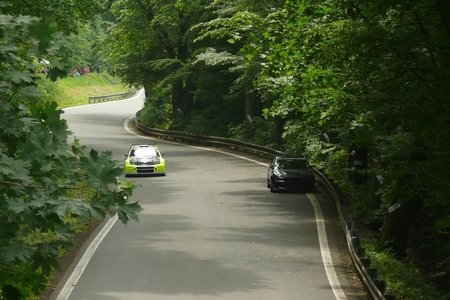
This annual of Ecce Homo held traditionally in Šternberk was 33rd edition of European Hill Climb Championship. However national and later international hill climb races have been run here regularly since 1971. The race is also counted toward the Czech, Slovak and Austrian national championships, historic national and FIA races, plus a couple of lesser known championships. All in all there were present over 155 cars, which is less than in Austrian Rechberg earlier this year but by Ecce Homo standard, it was largest number ever - if we do not consider two editions in the early 1990 when Ford Fiesta Cup was called to take part here and about 40 cars with twice as many drivers took the hill and that made the overall numbers a bit higher. But the quality, not only quantity was present this time. A bit darker message was spread a few days before the race: an Austrian driver Hanspeter Laber was killed instantly in a local Italian race, while running slowly down the hill after his racing heat. There was a question if his Austrian colleagues would not be missing. In the end, apart from the picture of his Escort, that we saw also in Rechberg, in the press room, there was no real influence of this tragedy on the Ecce Homo meeting.


The top driver competition was excellent. There were as many as ten drivers capable of running one heat under 3 minutes. Unfortunately the weather was probably the weakest factor of the weekend, so there were no new track records. On the other side, both days the rain stopped before the first heat and thus mainly only slower cars were affected by wet conditions and notably slower times. The main favourite for the overall honours was as usually Simone Faggioli in his Osella FA30 and he started to confirm his role from the beginning. By far closest to his time in the first heat was Marcel Steiner in a similar car. Marcel however then noticed some problem with the chassis and it was reported he would not take any further part in the meeting. Other big favourites Julien Duccommun or Joel Volluz were new to Ecce Homo, unlike Steiner or Faggioli, so they were learning the track rather than trying to run close to Simone's 2:53. Fastest local driver Miloš Beneš was almost as quick, though it was not expected he could break Faggioli's dominance. All those drove Osella FA30 version of latest Enzo Osella's sports car. They were running against formula cars (F3000, F3 or similar) in E2-SS class because of wearing just one seat in the middle of the cockpit, i.e. some kind of mid-80s Can-Am cars.


A proper two-seater version of this car is called PA30. There was just one exemplar present, unlike in Austria, but Fausto Bormollini was by far quickest driver with it in the E2-SC class beating also all open wheel formulas, which were led by local driver Otakar Krámský, who is former European Champion in the EHC and still regularly races in European Championship hill climbs. The second and third in the E2 Sports Car category were two Czech drivers, Dušan Nevěřil (8th overall, his best time was under 3 minutes) and David Komárek.


Now back to the top drivers. On Sunday morning it was announced that Marcel Steiner will start the race after Simone Faggioli help him to fix the chassis after having been considered irreparable in the paddock. These two then became the main competitors for the win. In the end Simone was by 4 seconds faster in both heats and won almost easily with his best time being 2:46.720 while his absolute track record is some one and half second better, though set under almost ideal conditions.


Duccommun was originally hoped to take the main challenge on Faggioli, especially after the expected withdrawal of Steiner. However, in the first heat he was trying too much and was way two quick at the higher part of the track, hit the barriers and crash the car. Not too heavily, but it was done for the day.


After Duccommun's retirement, there were simply two drivers left to fight for the final spot on the podium: Austrian Wolluz and Czech Beneš. Wolluz was third after heat one but Beneš was very quick in the second heat, when the time stopped at fantastic 2:51. In total it was Beneš who nosed Wolluz by only 0.09 seconds. They were five seconds behind Steiner in total calculation. Bormollini as a winner of the sports car category was another 10 seconds back.


The first 14 positions in the overall standings belonged to 3-litre cars: spiders, formulas, the dominating Can-Am type spiders and also one closed touring-based car. It was called Lotus Evora, though many few parts of any Evora were used. Dan Michl won with it the silhouette E2-SH class finishing 14th overall ahead a bunch of two litre formulas and prototypes. Best of them was an actor Ettore Bassi with his 2-litre Osella PA21 Evo, a former car of Simone Faggioli, who raced it in 2007.


The second fastest closed/touring car was an Audi TT-based DTM special in the hands of Czech driver Vladimír Vitver. Surprisingly quick was the best Group A car, a Mitsubishi Lancer Evo VIII driven by Jaromír Malý, who was third best closed/touring overall beating such cars as BMW M3 GTR E92 (third in E2-SH, Robert Šenkýř) or the powerful Lancia Delta Integrale in distinct orange colours brought here by popular Felix Pailer, the winner of the well supported E1 class, which consisted also from many cars that would normally fit the historic classes (first generation VW Golf, or Škoda 130 RS) but with such modifications that exclude them from the historic cars.


The true historic cars had their own official separate classification. The main battle should have been between Jaroslav Prášek, who brought here his new Chevron B23 and Martin Vondrák in Formula 2 March 712M, who was fastest in the wet practice. But in the first racing heat the latter had a collision with the safety fence, which left lone Prášek half minute ahead the nearest competitor, Petr Tykal in quite familiar MTX 1-03, the car that was used in great numbers during late 70S and 80s in the national formula racing. The third historic overall was Josef Michl, former very successful driver, for example in European Touring Car Championship, this time wheeling a nice yellow Porsche 911 SC.


One historic car, surely worth to mention was March HSS Audi Turbo Can-Am, driven here for the first time by Adam Klus, who bought it a few year ago. It is confirmed as former Miroslav Adámek Interserie car, which also appeared in Ecce Homo 1990 and set the new track record after the previous one survived for full 6 years. Klus was running the car really nowhere near its real potential, at times it even looked that there are some technical issues, he was said not to have wet tyres, etc. but the final 7th positions among the historic cars were nice for the team and we hope to see much more from the car and driver in the future.


By the way, veteran Miroslav Adámek was here personally as well. He was driving his NSU TT, a car he started his career in the early seventies. He is still quick enough and with this small touring car he managed to finish eleventh out of 25 classified historic cars. There were only three retirements unlike among the modern cars, where was counted 17 non-finishers.


It was a great race with possibly the most competitive entry ever and also despite the bad weather forecast, it was nice and not raining, though the spectators areas were full of mud. We would also like to praise organisers, who managed - especially during Saturday's practice sessions, keep the programme running very well, without too many delays, and almost everybody was surprise that a few minutes after half past two, both practice heats were over. On Saturday, there was a bad lack with crashed and various failures, especially among the first group in the first heat - sometimes even the first restarted car had not crossed the finish and the start of further cars had to be stopped - despite all that even the Sunday programme finished OK, partly because both groups (historic cars plus Group N & A, and the rest of E1 & E2 categories) were released together. Also the intervals were set to 45 seconds for entire weekend and it surely appeared better than standard one minute intervals used here in Ecce Homo for ages.


The Ecce Homo race was the fifth in the 2013 European Championship. Simone Faggioli is leading the Category 2 standing quite convincingly after having won in France, Austria, Portugal, Spain and now in the Czech Republic. The second is currently Fausto Bormolini, best E2-SC (sports car) driver, who scores points separately from E2-SS (single-seaters) and E2-SH (silhouettes). Miloš Beneš and Joel Volluz are next (both E2-SS). Vladimír Vitver is fifth overall as the best E2-SH driver after winning here and second position in Rechberg. Another Czech driver Otakar Krámský is sixth and is actually the most successful open wheel formula driver.