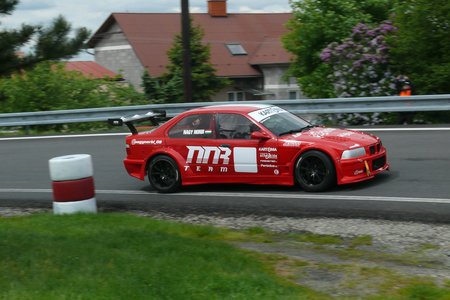
After one year hiatus, caused by the restrictions due to the so-called Covid pandemic, FIA European Hill Climb Championship returned to the Czech Republic to the famous Ecce Homo race. Despite the Championship being cancelled altogether last year, local organisers (AMK Ecce Homo Šternberk v ÚAMK) still tried to keep the Ecce Homo hill climb race as a national championship race. But even that attempt did not succeed.


Now we were back for the 40th European Hill Climb Championship annual of the race though the modern history starts in 1971 while the track was earlier used for circuit racing during the 1950s. And the very first records of racing here fall into 1905, when a stage of another race was held here.


The first European Hill Climb Championship race winner here was already in 1981 Jean-Louis Bos with his red long-tail Lola T298, who unfortunately as we have just learnt died recently. Only EHC race with a longer tradition is St. Ursanne, scheduled this year on 15th of August but apparently not definite to happen. Several race organisers already cancelled their EHC races, among them traditional Austrian Rechberg at the end of April, so that the common 12-race calendar is currently shrunk into 9 races.


While the top European drivers were all here, general participation was some 50% lower than in previous years. Just about 120 cars made it to the scrutineering, three of them failed and did not pass it. Those included both entered Lamborghinis (Gallardo and newer Huracan) for an expired fuel tank but were allowed to take part in the Czech Trophy, which was a support race. Another car was a brand-new KTM coupé, which has no proper homologation yet. In the class, when even just a front windscreen from the production model is enough for a silhouette to be allowed to race as a production car, this KTM failed, despite being way more 'production' than some of the cars that have already taken part in the class (the class have already seen cars like McLaren-bodied Norma prototype or Opel Speedster with a windscreen like Lotus Elise). This KTM was then seen on the track as a pre-run driver.


The race was usually held in the first week of June. This time it was moved to late May. And it was seen in the weather. It was colder than usual. Moreover for Saturday's practice sessions showers were expected. While in the morning, the track stayed mainly dry, in the afternoon it became completely wet and with no rain expected on the race day, most of the top drivers skipped the session so the practice was finished sooner than usual. There were nearly no incidents, so the programme went smoothly anyway.


The expected battle between the two favourites, Italians Christian Merli and Simone Faggioli, started in practice when Merli set 2:44 while Faggioli lagged with 2:47 and surprisingly local Czech driver Trnka 2:50. Merli drove a single-seater Osella FA30 (actually a closed-wheel prototype like the 70s/80s Can-Am), while Faggioli and Trnka were at the wheel of a proper open-top prototype called Norma M20 FC. This year Faggioli was more successful in direct battles but in Ecce Homo it was Merli who prevailed in all three heats (practice and 2 Sunday's race heats) and defended his victory from 2019 when he also beat Simone Faggioli.