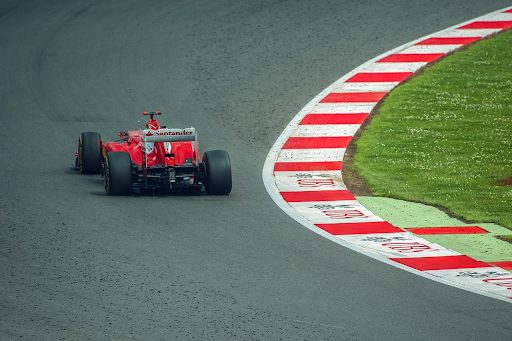
Modern engineering and cutting-edge technology merge with the drivers' elite athleticism to offer exhilarating races for the viewer's enjoyment in F1. All too often in F1, the focus is on the cars and their brand deals. Many focus on the aerodynamics of the vehicles, the logistics of the pit stop and the engine behind the supercars, but dismiss or forget about the mental and physical fortitude of the driver.
It is not a case of these elite athletes just sitting and steering; in fact, competing at the top levels of F1 requires an immense physicality to reach podium finishes. Some of the fittest athletes in the world are F1 drivers. But just how fit do they need to be to excel at this intricate and strenuous sport?
The Science - What is really going on?
Before exploring what is required and expected of an F1 driver whilst they are in the hot seat, it is worth exploring what they are putting themselves through and what driving one of these cars demands.
These colossal machines are quick, powerful and punishing when driven. For any driver to be in with a chance of a podium finish in F1, they are likely to experience 5 to 6 G force around corners, when braking or when accelerating, with some circuits pushing peaks even higher. That means that each and every driver is exposed to several times their own bodyweight pressing against them at any given point on a racetrack. Combine this with the sweltering heat inside the car and often outside in tropical countries and the lengthy periods of time the drivers spend racing, sometimes for more than 2 hours at a time, and you can see why F1 drivers need to be in tip-top physical conditioning. Without their extensive training and honed skills on the track, they are likely to fail or put themselves in danger.
With so much at stake on the track and such fine margins separating success from failure, it's easy to see why F1 has built such an obsessive global following. From predicting who tops final practice to debating a team's tyre strategy call, the precision and unpredictability of the sport is part of what keeps millions of fans tuning in every race weekend.
Science is as much an art in F1 as it is in any technical discipline. The sport turns on the tiniest of tech changes or the slightest adjustment to a driver's approach, and those margins are exactly what draw so many fans deeper into the data behind the sport. Readers looking to explore more detailed race-by-race analysis and driver form can find further reading over on Formula-1, where the same appetite for precision runs through every breakdown.
Cardiovascular Fitness
Endurance is vital for F1 drivers. They need to be fighting fit for hours on end. To ensure this, endurance training is a huge part of F1 drivers' training programs. They will commit to hours of training, whether it be running, cycling, rowing or swimming, to have a strong cardio base to work from. This allows the driver to be conditioned for times when the driver is put under cardiovascular pressure in race environments and allows them to be prepared for this to avoid mental fatigue or mistakes.
Many drivers will also train in altitude conditions or heat conditions. This is a way of mimicking what race conditions may be like. In the cockpit, things can get quite gruelling, with races in Singapore and the Gulf states regularly creating cockpit temperatures well above 50C (122F). The problem has become serious enough that the FIA now formally declares a heat hazard at events like the Singapore Grand Prix, where drivers can still lose up to 3kg in body fluids despite the extra safeguards, and cooling vests are set to become mandatory across high-heat rounds from the 2026 season. Having a strong cardiovascular fitness base to cope with this kind of thermal load is essential.
Strength Training
F1 drivers are no different from any other elite pro athlete. They need to hybrid their training between cardio and strength. Whilst they depend on cardio to maintain their energy through long races, F1 drivers also rely on their upper body strength. Turning corners at high speed requires a great deal of strength, especially when there is no steering assist involved. F1 drivers will consistently engage their core to stabilize and maintain a rhythmic breathing pattern. This allows them, in turn, to focus mentally and transfer weight from the upper to the lower body. A lot of this work comes down to the core muscles, which is part of why F1's own breakdown of how drivers train puts core and stability work right alongside the more obvious neck and cardio sessions. Whilst F1 drivers are not bodybuilders and need to remain lean for racing purposes, they also have to strike a balance and have strength in their upper body.
Uniqueness of neck movement
Due to the weight of their helmets and the HANS (Head and Neck Support), F1 drivers can sometimes have up to 25kgs bearing down on their head during quick turns at high G-forces. This is an immense pressure on the neck and would typically cause damage to people not trained or used to such weight. This unique pressure on the neck requires F1 drivers to implement neck exercise into their training routines - not something that your standard athlete would be partaking in.
Many will use resistance bands and isometric holds during their training to build up their neck muscles and may also train whilst wearing a helmet for familiarity. This is especially important for the drivers to maintain during the offseason when the body gets used to not being in the car and is essential to F1 drivers who want to maintain precise steering whilst bearing such weight.
Mental Fortitude: Concentration and Reactions
Whilst F1 drivers have to be in peak physical fitness to perform well, they have to train their cognitive fitness just as much. Drivers have to be as sharp as a tack to succeed at the highest levels. Training reaction times and honing these skills is imperative, with the average reaction time for F1 drivers sitting at 0.2 seconds, exceedingly quicker than the average Joe.
To maintain this, F1 drivers will concentrate on building skills in hand-eye coordination and video game simulators. They also tend to use light boards to hone these reaction skills. These sorts of training programs not only improve reaction times but also refine spatial awareness, memory and general cognitive functioning.
In the modern age and with such a great deal of technology at their disposal, F1 drivers will use specially created racecrafts that simulate racing environments to test and enhance their skills.
Finally
Like it or not, F1 drivers are elite athletes. To some, it may seem like an easy gig sitting and driving in a car, but these athletes endure much more than that. Their daily routines are extensive and rigorous to allow them to gain an edge and better their fitness. The brutal G-forces, heat and constant decision making they undertake in every race require vast amounts of physical and mental fitness. Whilst some may think it's just the car that is engineered to perform at such levels, in reality, these drivers are not just going for a Sunday cruise, they are at the peak of athletic fitness too.