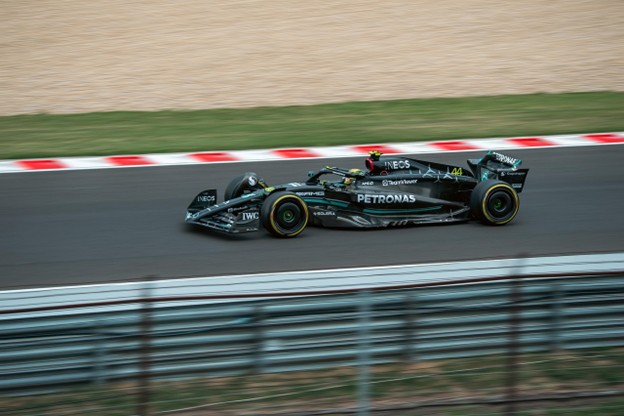
Mercedes F1 Car - Source: Pixabay
Is there a more combustible ingredient in an F1 title race than the moment a championship contender watches his car die beneath him? At the Canadian Grand Prix, George Russell found out the hard way.
Antonelli Wins Again, Russell in Disarray
A power unit failure while locked in an epic wheel-to-wheel fight with his teenage Mercedes teammate Kimi Antonelli ended his afternoon on the spot — and as Antonelli converted that battle into a fourth consecutive race victory, Russell's championship deficit stretched to 43 points. Catastrophic, surely. Season-defining, certainly. And if online betting sites are to be believed, it could well be the moment that the young Italian took a seemingly insurmountable step toward becoming the youngest champion ever.
When it comes to F1, you can place your bets at Bovada Sportsbook, and the American bookmaker now makes Antonelli a clear 1/2 favorite to claim the title this season. Russell, meanwhile, after being considered odds-on in preseason, is now a 9/4 shot. But whether Montreal represents the moment his 2026 title bid died or the moment it was galvanized is a question F1 history suggests cannot yet be answered.
Formula One is littered with retirements that looked terminal in real time and proved to be anything but — moments that served as catalysts rather than conclusions, traps that, paradoxically, released something ferocious in the driver they swallowed. Here are three championships that refused to follow the script.
Lando Norris — 2025 Dutch Grand Prix
Heading into the summer break, Oscar Piastri had quietly but convincingly established himself as the man to beat. The young Australian had looked imperious through the middle of the 2025 season, accumulating victories with a composure that belied his years. Norris — widely the pre-season favorite — had been haunted by qualifying inconsistencies; he'd held his best championship lead of 23 points after winning the season-opening Australian Grand Prix, but Piastri had steadily wrestled that advantage away. By Zandvoort, the Australian led by nine points.
On Lap 65 in the Netherlands, smoke erupted from Norris's McLaren — a Mercedes power unit failure — and the Briton abandoned his car at the foot of a sand dune, clutching his head as Piastri powered to victory with Max Verstappen second. Piastri was now 34 points clear with nine races remaining. The title had the look of a formality.
What followed was anything but. Piastri endured the worst weekend of his F1 career in Azerbaijan — crashing in qualifying, jumping the start, then crashing again on the opening lap. In Singapore, Norris aggressively barged past Piastri on the opening lap while fighting for third, cementing crucial podium positions. Victories in Mexico and Brazil propelled Norris to the top of the standings for the first time since April.
McLaren's double disqualification in Las Vegas for a technical infringement and a strategy error in Qatar sent the fight all the way to a final-round decider in Abu Dhabi. Norris started second, was overtaken by Piastri early, but held off Charles Leclerc's Ferrari to finish third — all he needed. Verstappen won the race but ended the season two points behind Norris, delivering the Briton his first world championship in the most breathless of finishes.
From a sand dune in Zandvoort to the top of the world in Abu Dhabi: a 34-point deficit erased.
Lewis Hamilton — 2014 Belgian Grand Prix
Spa-Francorchamps has hosted extraordinary Formula One moments, but few carried the venom of Lap Two in 2014. Nico Rosberg's front wing found Lewis Hamilton's rear tire in a failed overtaking attempt, puncturing it, ending Hamilton's race, and detonating the most poisonous atmosphere in recent Mercedes history. Hamilton told reporters that Rosberg had admitted in a team meeting to the contact being deliberate — an allegation that sent shockwaves through the paddock while Ricciardo, serene amid the wreckage, collected his third win of the season. Rosberg's lead stretched to 29 points. Seven races remained.
What Hamilton did next remains one of the all-time great championship responses in modern F1. Six wins from the final seven races — Italy, Singapore, Japan, Russia, the United States, Brazil — a run of dominance so emphatic it rendered the Belgian controversy ancient history by November. Rosberg, carrying the weight of that afternoon in the Ardennes, couldn't match him. The title wasn't close. Hamilton's fury had become fuel.
Sebastian Vettel — 2012 Italian Grand Prix
Vettel arrived in 2012 as the sport's dominant force — a back-to-back world champion who had obliterated the field with 11 wins from 19 races the previous year. But 2012 refused to follow the script.
The campaign was extraordinary in its unpredictability, with seven different drivers winning the first seven races. Contact with a backmarker in Malaysia had left Vettel outside the points; alternator failures had already forced retirements from both the European and Italian Grands Prix. After Monza, he'd fallen from second in the championship all the way to fourth — behind Fernando Alonso, Lewis Hamilton, and Kimi Räikkönen. A fourth consecutive title looked remote.
Yet what happened next defied belief. Vettel and Red Bull found another gear entirely. Five months and ten rounds on from his first and only win of the year in Bahrain, the German reeled off three consecutive victories — Singapore, Japan, South Korea — then a fourth at the Indian Grand Prix that secured him a 13-point lead with just three races remaining. Alonso, who had managed the championship lead with admirable consistency in a Ferrari that was rarely the fastest car, found himself being swallowed by the very momentum he'd so carefully constructed.
The title was decided in Brazil in the most dramatic circumstances. Vettel was spun round in a collision with Bruno Senna on the opening lap, dropped to the back of the field, and fought through the entire order to finish sixth — securing the championship by just three points from Alonso in one of the most improbable title defences the sport has ever witnessed. Four alternator failures, backmarker contact, four championships in four years. Monza had looked like a trap door. It turned out to be a doorway.