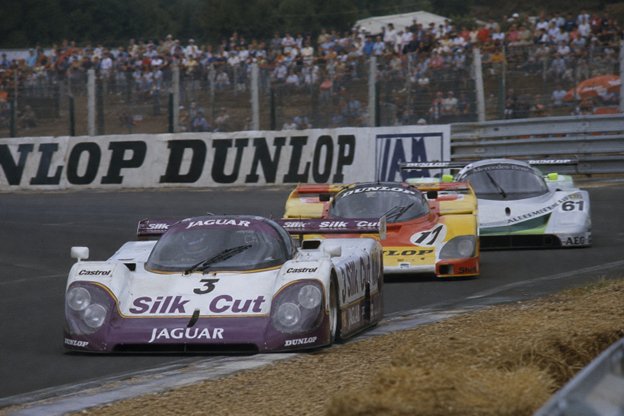
Between 1982 and 1993, sports car racing tore itself loose from anything resembling restraint. The rulebook was almost embarrassingly short — give the car a closed cockpit, a roof, a minimum weight, and a fixed fuel allowance for the race. Beyond that, engineers were free to do whatever they liked, almost like developers working with a flexible casino API by BGaming: turbocharged flat-six? Sure. Rotary? Go ahead. A naturally aspirated 7-litre V12 lined up against a 3-litre twin-turbo V6? Why not. The grids looked less like a spec series and more like a mechanical zoo someone had let off the leash.
Some racing eras you study. Group C you feel.
This was the era when Le Mans cars hit 400 km/h on the Mulsanne straight in the dark. When a Porsche 956 lapped the Nordschleife in 6:11. When a rotary-powered Mazda howled past the line at La Sarthe and pulled off a result no Japanese manufacturer had ever managed before. And, sadly, when some of the fastest drivers of their generation paid for those speeds in ways the sport has spent thirty years trying to forget.
A fuel formula that accidentally created legends
The genius of Group C was philosophical. The FIA didn't try to control how fast the cars went — it controlled how much energy they were allowed to spend getting there.
Each car had a fixed fuel allocation per race. At Le Mans, that meant roughly 2.550 litres to cover 24 hours. Run rich and chase qualifying laps and you'd be stranded by Sunday morning. Run too lean and you'd watch the Porsches and Mercedes drift away from you. Engineers had to balance combustion efficiency, aerodynamic drag, mechanical grip, and reliability all at the same time — and somehow still produce 700 horsepower out of whatever exotic engine they'd decided to bring.
That openness pulled in everyone. Porsche, Jaguar, Mercedes-Benz, Mazda, Toyota, Nissan, Peugeot, Lancia, Aston Martin. Plus smaller outfits like Sauber, Joest, Brun, Kremer, Spice, WM. By the late 1980s, a top-tier Group C grid had more manufacturer variety than Formula 1, the WRC, and IndyCar combined.
The cars that defined it
You couldn't ask for a more varied roster. A Porsche 962 weighed roughly the same as its rivals and lapped within a second of them, but underneath, every car was a different argument about how to win a 24-hour race.
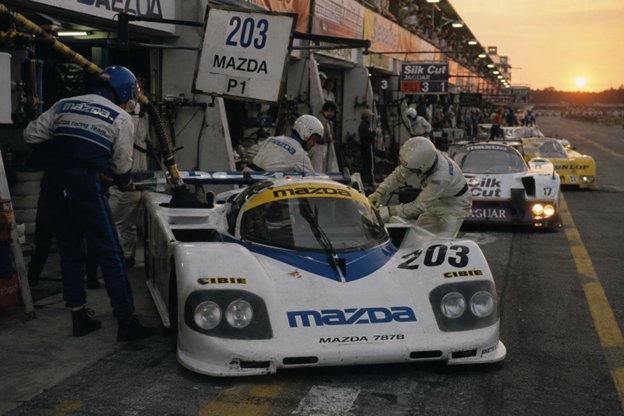
Every one of those cars sounded different. The Mazda screamed past 9.000 rpm with a noise no piston engine has ever quite managed to imitate. The Jaguar V12 was a deep, dirty baritone. The Sauber-Mercedes hissed and roared on boost like a freight train falling down a hill. Hearing a Group C grid pull away from the line at Silverstone in 1990 is the closest motorsport has ever come to opera.
The Mulsanne years
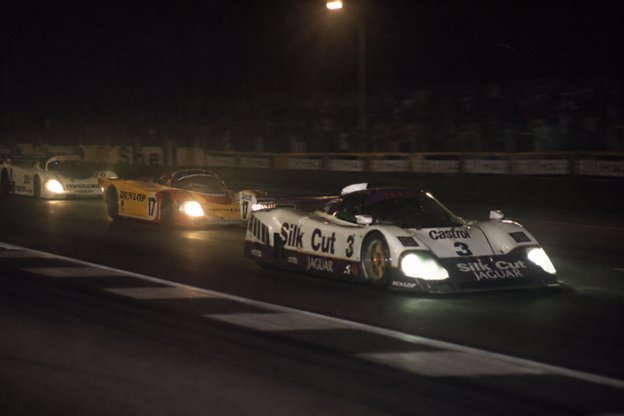
If one stretch of asphalt sums up the madness, it's the old Hunaudières straight at Le Mans. Six kilometres of public road, flat out, no chicanes until 1990. A few details worth knowing:
● In 1988, Roger Dorchy hit 405 km/h on the Mulsanne in a WM-Peugeot P88 — a number the FIA effectively legislated against the following year.
● The Sauber-Mercedes C9 routinely held above 400 km/h for nearly thirty seconds at a stretch in 1989.
● Drivers spoke openly about the car going light over the crest past the Hunaudières café, at speeds where lifting off the throttle wasn't really an option.
● Two chicanes were introduced for 1990, killing the top-speed era overnight but almost certainly saving lives.
That straight is the reason Group C lives in motorsport mythology. Every other detail — the fuel formula, the variety of engines, the manufacturer count — could have happened anywhere. The Mulsanne made it spectacle.
Moments worth knowing
A short list of the things any newcomer to the era should look up:
● Stefan Bellof's 1983 Nordschleife qualifying lap. 6:11.13 in a Porsche 956. A record that stood for thirty-five years until Porsche themselves finally broke it with a stripped-out 919 Hybrid Evo running on downforce levels that would have been illegal in 1983.
● The 1988 Le Mans. Jaguar finally breaks Porsche's seven-year stranglehold. The Silk Cut XJR-9LM of Lammers, Dumfries and Wallace survives a late gearbox scare to win.
● 1989, Mercedes returns. The Sauber-Mercedes C9s take 1st, 2nd and 5th at Le Mans — the first works Mercedes victory at La Sarthe since 1952.
● 1991, Mazda's rotary miracle. The orange-and-green 787B of Weidler, Herbert and Gachot wins outright. Still the only rotary winner in the history of the race.
● The end. 1992. The FIA tries to force the category onto 3.5-litre Formula 1 engines. Costs explode, manufacturers walk away, and within two seasons Group C is dead.
The cost, and the long shadow
It would be dishonest to write about this era without admitting what it cost. Bellof, one of the most gifted drivers of his generation, was killed at Spa in 1985 trying to pass Jacky Ickx's Porsche at Eau Rouge. Manfred Winkelhock had died at Mosport a few months earlier. Jo Gartner was lost on the Mulsanne in 1986. The cars were astonishing. They were also a long way behind the speeds they were doing in terms of safety.
What's left behind is a body of footage, photographs, and stories that fans still trade like currency. Group C has aged better than almost anything else in motorsport because it never had a real successor. Modern LMH and LMDh cars are quick, varied, and beautifully engineered — but they're regulated to a parity their predecessors would have laughed at. No one will ever throw a rotary at Le Mans again and beat the Mercedes. No one will hit 405 km/h on a public road in the dark.
For roughly a decade, sports car racing had no rules worth speaking of, and the result was the most varied, sonically alive, and dangerously beautiful era the sport has ever produced. Group C wasn't a category. It was an argument about what racing should be — and the answer it gave hasn't been topped since.