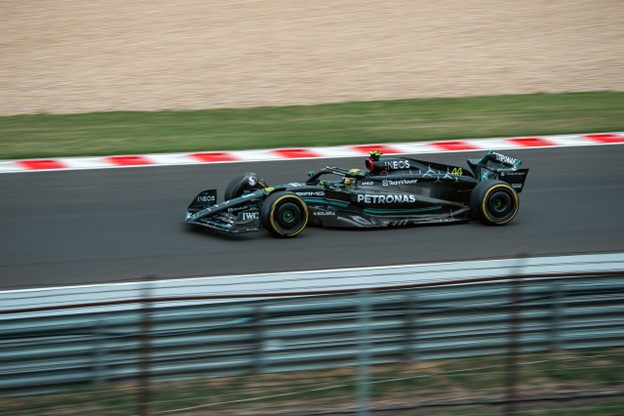
Lewis Hamilton in his Mercedes days - Source: Pixabay
Heading into the 2026 Formula 1 season, Mercedes were the frontrunners once again. They had spent the better part of the last year preparing for the 2026 regulation changes, rather than focusing on the championships immediately at hand. And that decision looks like it will bear fruit.
Mercedes Fly Out of the Blocks
George Russell began the campaign with a win in Australia. His teenage teammate Kimi Antonelli has since taken over, winning back-to-back races in China and Japan, becoming the youngest championship leader in history in the process. Now, online betting sites predict a Silver Arrow civil war at the top of the championship standings.
The bookies make Russell the even-money favorite to claim the title, with Antonelli just behind at 11/10. If you were to calculate implied probability at Thunderpick, you'd discover that those two own a whopping 97% share of the market, with the other 20 drivers on the grid forced to share 3% between them.
But here's the uncomfortable truth for all at Mercedes: Formula 1 has a habit of humbling the favourite. Three times in the modern era, a team arrived wearing the fastest chassis in the opening rounds, led the championship with apparent authority, and then watched it unravel. Let's take a look at each of them.
Hamilton's Heroics
In 2008, Ferrari arrived with genuine championship ambitions and the tools to back them up. After Lewis Hamilton won the Australian opener, Ferrari proceeded to win the next four races — reigning champion Kimi Räikkönen in Malaysia and Spain, Felipe Massa in Bahrain and Turkey — establishing themselves emphatically as the team to beat. Four wins from five rounds. It looked, in those early spring weeks, exactly as commanding as Mercedes' three from three does now.
But Hamilton, motivated by his spectacular collapse the previous year, refused to be shaken. Wins at Monaco, Britain, and Germany kept him firmly in contention through the summer, and by the time the field reached Brazil for the finale, the championship was impossibly tight. What followed remains one of the most dramatic closing laps in the history of the sport.
Hamilton needed a fifth-place finish. In the final stages, rain scrambled strategies, and he slipped down to sixth. Massa won the race and was World Champion for all of 40 seconds. Then, with one corner remaining, Hamilton swept past Timo Glock's struggling Toyota to reclaim fifth. One position needed; one position secured; first world championship by the cruellest possible margin. Ferrari and Massa were denied in the final hundred metres of a season-long battle.
The parallel for 2026 is almost uncomfortable to state. Ferrari's four wins from five looked every bit as dominant as Mercedes' three from three looks now — yet the title still slipped away at the final corner of the final lap. Early dominance means nothing when the pressure becomes unbearable. Russell and Antonelli would do well to remember Brazil; the championship isn't decided when you're dominating in March.
Abu Dhabi Rewrites the Script
13 years on from his maiden crown, Hamilton entered the 2021 season as a seven-time world champion and proceeded to underline exactly why, winning three of the opening four races to build a cushion that suggested a record-breaking eighth crown was on the horizon. Max Verstappen hit back with characteristic fury — victories in rounds five, seven, eight, and nine made absolutely clear this would be no procession.
Then came Silverstone. The title rivals collided on the opening lap; Verstappen's Red Bull ended in the barriers; Hamilton received a ten-second penalty and still won. The gloves were firmly off from that moment. Wins traded back and forth all season; tensions between camps running high, championship mathematics shifting dramatically with almost every round.
By the Abu Dhabi finale, they were level on points. As tight as it gets. Hamilton led from the first corner until the last lap and was on course for his date with destiny when Nicholas Latifi's crash brought out a late safety car. What followed sparked a debate that still hasn't fully been settled. Race director Michael Masi directed only the five lapped cars between Hamilton and Verstappen to unlap themselves — a procedure that had never been applied selectively before — and brought the safety car in at the end of that same lap, creating one final lap of racing.
Verstappen, on fresh soft tyres against Hamilton's worn hards, pounced down the straight, overtook Hamilton into the hairpin, and claimed the championship. Early-season dominance rendered completely irrelevant by a decision made in the final fifteen minutes by a now disgraced race director, silenced by an NDA.
Ferrari's Collapse
Of the three cautionary tales, none carries quite the same chill as Ferrari's 2022 campaign. Charles Leclerc won two of the first three races as Verstappen — crucially — suffered retirements in both Bahrain and Australia. For a brief moment, Ferrari appeared to have built a championship-winning car. The tifosi were dreaming with good reason, and the paddock was talking about an early end to Verstappen's dominance.
Then the collapse began.
Spain: retirement from the lead, power unit failure. Monaco: a disastrous strategic call cost Leclerc a near-certain victory from pole position. Azerbaijan: another reliability failure while running at the front. Power unit failure. Strategic catastrophe. Driver error. Ferrari dismantled their own championship lead brick by brick. France was the lowest point — Leclerc crashed out while leading, a wholly avoidable mistake at a circuit where he had been fastest all weekend.
Verstappen found his rhythm, began accumulating victories with ruthless efficiency, and wrapped up the title with four races to spare, eventually finishing 146 points clear.