It became a tradition that the first May week the FIA WEC moves to Belgium for the 6-Hour of Spa-Francorchamps race, which is usually the second race of the season, as well as the final shakedown for the team before the season highlight, 24 Hours Le Mans in June. This year, it was the first time in the modern history of the Spa race when there were no additional entries among the factory LMP1 teams. Usually, Audi, Peugeot and more recently Porsche took their third, or even fourth Le Mans cars to Spa. But this year, there are no LMP1 additions in Le Mans, so no LMP1 additions in Spa. Simply as that. All due to Volkswagen diesel affair - both Porsche and Audi decided not to field their third car in Le Mans this year. Hopefully this gets back to the more traditional mode in the coming years, i.e. more factory cars in Le Mans and the same in Spa.


So the only new, non-WEC regular entry was the former-Jota Zytek, now running in orange livery, under the G-Force banner, as a Russian entry. This team, as a Jota Zytek, later renamed Gibson, which is ELMS regular, enters WEC race in Spa regularly since the new era WEC creation since 2012, and the team finished on LMP2 podium every year. From four starts, the team won twice, and finished second and third in the remaining two races. So the question for them is: would they continue their great achievement among the every year stronger LMP2 field?


This year the meeting is set to be held under really great weather, the forecast is really good and the first two days, filled with three free practice sessions and GTE and LMP qualifyings, confirmed that: sunny, dry and pleasantly warm was the only kind of weather, drivers, teams and spectators could feel so far.


Free practice
The first practice session on Thursday suggested that Porsches would be back in front, following slight Audi dominance in the previous Silverstone meeting. But more surprisingly Toyota was not only equal opponent to the Audi, they were usually slightly better. In the first session the Toyotas were third and fifth. In the second session the Toyotas were even 1-2. But Porsches did not improved in the afternoon session, however still the positions after the first day were: Porsche-Toyota-Porsche-Toyota-Audi-Audi. Note that Audi no.8 did no beat the 2-minute time as the only factory LMP1 car - but it also suffered front axle drivetrain problems and skipped the second session altogether.


The Friday WEC programme continued with the final shorter (1-hour) practice session. It had Porsches again at the top, one car improving by more than a second to 1:56.465, more then 1.5 ahead of its sister car. Audis were again only fourth and sixth. Audi no.8 still not under the 2-minute time. Counting all free practice session times together, we would get a pattern like this: Porsche-Porsche-Toyota-Toyota-Audi-Audi. Fastest Rebellion no.13, which also lead the privateer LMP1 subclass was just 2 seconds behind the slower Audi. Lotus-based CLM then beat the second Rebellion in the final session and end up 8th fastest in practice session totals, with about a half second advantage over the no.12 Rebellion. The best LMP2 car was G-Driver Oreca coupe ahead of the new Alpines coupe, both based on the same Oreca prototype, just wearing different homologation name. By the way, this year is the last session for the open top prototypes.


They were disallowed in LMP1 a few seasons ago, now they are still surviving among LMP2s. Only two of them are present here: both are Gibsons, which are actually rebadged Zytek - one of the oldest LMP2 design, with a roots in an era of cars with full-width rear wings and no mandatory fins - to these days, they belong to the most aesthetically appealing open LMP cars. Next year, with the new LMP2 regulation in force, they would be gone anyway. There are no more Morgans/Pescarolos, 03-Orecas or old Alpines.


Qualifying
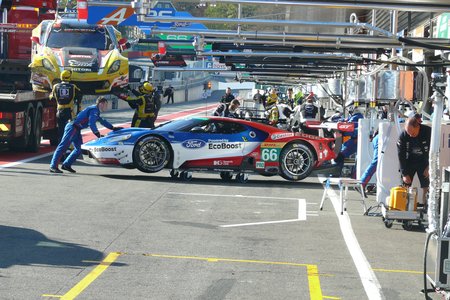
Friday's qualifying started with a 25-minute GTE session. It was still pretty warm and sunny. We have not yet mentioned that the class invited two new notable entries this year - factory Ford GT led by Chip Ganassi from the United States. This is a very nice and appealing car and it already gained a lot of fans. During the practice sessions the Fords set decent times but never reached the top of the GTE sheets. Not to say that all GTE cars were actually very close, rarely notably exceeding 2 second range. In qualifying it was a bit different, not only because the top PRO teams improved a lot. But also because the fact that to qualifying order the average of times of two selected drivers counts, and with the AM (amateur) teams sharing drivers of rather different quality, the second driver was 5-seconds slower on average - which made the GTE Am team uncompetitive the to fully professional entries. Moreover this year a new GTE rule went in force and with the GTE Am class requiring one-year old specs. cars, there was a notable visual difference for example in Aston Martins Pro and Am, not to speak about Ferraris, where the new 488 GTE model was run in the Professional class. On the other side, Porsche discontinued their factory Manthley GTE team so only Porsche Pro car was fielded by Proton Racing. Despite their usual great effort, they could neither match the new Ferraris which dominated GTE qualifying, not the two Aston Martins and Fords, which would share the second and third GTE row. Note to say that Astons were great during the free sessions, often in the lead, but Fords almost never made it among the top three in class.


The prototype session continued right after the GTE cars were parked in the pits. This time both Porsches seemed to be more dominant then in previous sessions. Easily took the front row, but still were off the pace set last year - off course with advantages rules back then. So the improvement in technical areas was obvious, how technicians despite restrictions affected the power of the cars could improve them again. Porsche press release considers only hotter weather to be the reason they could not bear last year times. Audi were third and fourth in provisional qualifying standings but the second drivers were faster in both Toyotas, while the second Audi drivers were notably slower and 'helped' the Toyotas to get third and fifth grid spots for the tomorrow's race.


Rebellions now took 1-2 among the LMP1 privateers while G-Force Oreca no.26 once again topped the LMP2 class. Signatech Alpine was classified second ahead another Oreca 05 - it was one of new Manor entries. G-Driver (ex-Jota) Gibson was fourth fastest, so a potential to gain the podium finish is there again. Neither of three present Ligiers or two newly built BR01 did a good result in qualifying. Strakka Gibson finished very low too, which is really disappointing for the team with a healthy history.


Everything is set for a good race tomorrow. Porsches would probably slightly dominate the race, at least in the first phases. A question is whether Toyotas would continue beating Audis and how the team will deal with pit stops, tyres, tyre-change strategies and also traffic. It was in Silverstone when one Porsche was eliminated by a GTE car collision, which actually help the Toyota team to lead the manufacturers’ championships before Spa. Would Toyota continue leading before Le Mans? Let's see tomorrow.


Race
The race start was scheduled a bit late, as it is common in Spa, at 14:30. Grandstands were full of spectators - possible increase compared to last year attendance, sunny, warm almost ideal weather and after two warm up laps the race was started. Something, that would later become a 'Race of survivors', started with both Porsches at the top, Audis moved ahead Toyotas and Rebellion followed by CLM continuously moved away from the rest of LMP2 and GTE field. After a few laps the Toyotas started attacking Audis. But firstly the second running Porsche slowed down letting both Audis and Toyotas pass by. The Porsche no.2 then continued at this slower pace until the end of the race. It was apparent that the hybrid system is not working, and the team soon confirmed this. While the race looked lost for the car, the final result would be surprising.


After about half hour of the race both Toyotas were already running ahead of Audi no.7 while the Audi no.8 was still keeping second position behind very fast running Porsche no.1, which had really no opposition until the first series of pit stops. This series moved Toyota no.5 into the lead ahead of Porsche no.1, while the other Toyota pitted too long and lost almost one lap. The Porsche no.1 was then closing the leading Toyota and this ended with a nice battle for the first position in the race. The Porsche overtook the Toyota and briefly led but Toyota immediately replied and took the lead back - the Porsche lead even did not appear on the lap chart, despite being quicker at this stage of the race, as it suffered a puncture during the next lap. It lost some time, having other puncture later again, but more notably in the middle the gearbox had to be changed which completely eliminated the Porsche no.1: for 1 hour and 40 minutes it was stationary in the garage. It later rejoined just to be classified and score points for Porsche.


Now with both Porsches out of the game, Toyotas started to control the race. Especially after the Audi no.7 lost 4 laps repairing overheating issues and dropping to 19th overall, their only real competitor was the Audi no.8, which was running second. One of the Toyotas still could not eliminate the loss in the first long pit stop. It looked very well for Toyotas, especially when the third placed car no.5 caught Audi no.8 and overtook it - despite still one lap down. Unfortunately, the next lap the Toyota no.6 turned to the pit lane, was pushed into the garage. Later it was claimed a retirement. The reason was electrical issued which damaged engine. It was the only LMP1 retirement in the race.


Toyota no.5 continued to lead the race with a safe margin ahead of Audi no.8. After four hours it was already more than one lap ahead of the Audi and it was set for a great Toyota win in the race. Unfortunately, after further three laps a huge smoke appear at the back of the Toyota and it was driven on to the garage. The car had already completed enough laps to be classified, so it was send for the final race lap after the sixth hour on hybrid power only to finish the race formally and get championship points. It was still classified 2 laps ahead of the Porsche no.1.


So with all factory cars suffering problems of various kind, the only survivor Audi no.8 stayed in front with a huge 2-lap margin ahead of slowly running Porsche no.2. All others factory cars were more or less out of the game, so Rebellions stepped up to the third and fourth overall. Only the recovering Audi no.7 could be some danger for them. In the end the Rebellion no.13 finished 2 laps behind the 'non-hybrid' Porsche no.2 while the other Rebellion was one lap down securing fourth place ahead of the Audi no.7 by only 6 seconds. Had the Audi avoid a collision in the final half hour of the race, possibly the Rebellion could not keep it. In any case Audi won the race ahead of Porsche that seemed to be out of contention pretty early in the race. And Rebellion took another podium finish following their success in Silverstone, the previous race.


LMP2 class saw great battles for the lead with many cars appearing at the front (continuously G-Drive Oreca no.26, Alpine no.36, Manor-Oreca no.44, Manor-Oreca no.45 and ESM-Ligier no.31, in total 12 lead changes). Several other cars regularly appeared among the top 3 and in the final stages of the race, there were no less than four car running close together, separated only by a few seconds. In the end the lucky one was the Alpine no.36, 7th overall, behind the CLM/LMP1, which was delayed in the middle of the race with several pit stops, but manage to overtake all LMP2 cars back. The close second was the ESM-Ligier no.31, 3.5 seconds back. Manor-Oreca no.45 fight the 3rd position in the final laps by overtaking RGR Sport by Morand-Ligier. All these cars were separated by only 6 seconds. The former Jota-Zytek, now G-Drive-Gibson ran well but it was not enough to get the podium again. Fifth place was probably the best they can do in this tough competition.


GTE Pro class was only about Ferraris. They controlled entire race and even Aston Martins, which began the race third and fourth could never actually match them. One of Astons was then eliminated in a rollover accident, while the other car suffered issues, which helped Fords to gain third and fourth GTE Pro positions in the middle of the race. However with 70 minutes to go the third running Ford no.66 had a huge accident in Eau Rouge. The car was completely destroyed and Safety Car dominated the track for more than 30 minutes. The other Ford no.67 moved to third. The GTE Pro race looked decided but with less then 10 minutes to go, the Ferrari no.51 which led most of the race (except short one or two lap period during pit stops) turned to the pits. It looked as last splash and dash but instead it was move to the garage and retired. So the sister car, Ferrari no.71, won the race quite unexpectedly and the Ford no.67 moved to the second position. Aston Martin no.97 completed the podium, finishing pretty close behind the Ford, less than 2 seconds. So great battle among GTE too.


The final WEC class, GTE Am was mainly a battle between the lone Ferrari no.83 and the lone Aston Martin no.98. They were well supported by another lone car, the Larbre Corvette and three Porsches but only Ferrari and Aston shared the highest spot anytime in the race. In the end it was the Aston Martin that took the honours. The Corvette completed the podium.


Generally it was not the best or most dramatic race in WEC, except maybe the first 90 minutes, it was more a race about those that survived. The gaps among top running cars were probably among the biggest one in recent WEC history but still it was nice race, which saw great battles especially in LMP2 but also shows potential but also weaknesses of all of the three manufacturers ahead of Le Mans. The first half of the race looked very promising for Toyota, which was fully back and seemed to have most chances of winning this race. Porsche was fastest on absolute lap speed but proved least reliable, Audis were slowest of the three but could field the only car without any major issues and thus took the victory. Not easy to make any analyses ahead of the Le Mans 24 Hours. The situation seem to be quite open. Porsche won last year but in Spa both car had notable issues. Toyota looked great but could they solve their electronic problems damaging engines? Would the Audi be then the favourite for the win? Possibly yes, but the race would be possibly full of surprises, maybe having a huge differences between running relatively early in the race - should similar pattern from Spa repeat again in Le Mans.